
Best Air Quality Monitor: 8 Indoor Picks for Every Home
Last updated: October 14, 2026 · Product details checked on Amazon.com
Quick answer: The best air quality monitor for most homes is the Airthings View Plus, the rare consumer unit that tracks radon, fine particles (PM2.5), CO2 and VOCs together, with a readable screen and a strong app. If you mainly want to know when a room needs fresh air, the Aranet4 is the CO2 meter to beat. Alexa households get the most for the money from the Amazon Smart Air Quality Monitor, and the BREATHE Airmonitor Plus covers eight readings on one screen for about $100. On a tight budget, the GoveeLife H5106 (PM2.5) and the Temtop portable CO2 meter cost under $40 each.
Top Picks at a Glance
| Best overall | Airthings View Plus — radon, PM2.5, CO2, VOC, Wi-Fi |
| Best CO2 monitor | Aranet4 Home — NDIR sensor, years of battery |
| Best for Alexa homes | Amazon Smart Air Quality Monitor — 5 readings, Routines |
| Best all-in-one screen | BREATHE Airmonitor Plus Gen 2 — 8 readings on one display |
| Best for basements | Airthings Wave Plus — radon, CO2, VOC, battery |
| Best handheld analyzer | Temtop M2000 — CO2, particles, formaldehyde |
| Best budget PM2.5 monitor | GoveeLife H5106 — smart, under $40 |
| Best cheap CO2 meter | Temtop Portable CO2 Monitor — about $30 |
Most of the things that make indoor air unhealthy are invisible. You can’t smell carbon dioxide building up in a closed bedroom, you can’t see the fine smoke particles left behind after searing a steak, and radon gas seeping up through a basement floor gives no sign at all. An indoor air quality monitor turns those invisible problems into numbers you can act on: open a window, run the range hood, switch on a purifier or call in a radon contractor.
The trouble is that “air quality monitor” covers everything from a $30 CO2 meter to a $330 radon-and-particle station, and the sensors inside vary just as much. A monitor that can’t measure what’s actually wrong in your home is no use however nice its screen looks. This guide explains which sensors matter, which ones are mostly guesswork, and which eight monitors are worth buying in 2026.
How We Chose These Monitors
We picked these monitors on our own; no brand paid for placement or supplied free units. In October 2026 we reviewed each model’s Amazon listing and manufacturer documentation — the sensor types used (especially whether CO2 is measured by a true NDIR sensor or estimated), the pollutants covered, display, app, power source and smart-home support — recorded prices, star ratings and review counts, and read through owner feedback for recurring complaints such as drifting readings, app trouble and dead sensors. Accuracy figures are the manufacturers’ own; we haven’t lab-tested these units.
What Is the Best Air Quality Monitor?
The Airthings View Plus is the best air quality monitor overall because it combines radon, PM2.5, CO2 and VOC sensing with a clear display and app. The Aranet4 is the best dedicated CO2 meter, Amazon’s monitor is the best value for Alexa users, BREATHE’s Airmonitor Plus shows the most readings per dollar, and the GoveeLife H5106 and Temtop CO2 meter are the best cheap options.
1. Best Overall: Airthings View Plus


Airthings View Plus Radon & Air Quality Monitor (2960)
A Wi-Fi monitor that tracks radon, fine particles (PM1 and PM2.5), CO2, VOCs, humidity, temperature and air pressure in one box, on a glanceable e-ink screen, running on batteries or USB power.
- Radon, PM1/PM2.5, NDIR CO2, VOC, humidity, temp, pressure
- Wi-Fi + app with history and alerts; doubles as hub for other Airthings units
- Battery (up to ~2 years) or USB powered
- Customisable e-ink display
- ✅ Only mainstream monitor combining radon and particles
- ✅ Excellent app and long-term graphs
- ✅ Cable-free placement
- ❌ Expensive
- ❌ Radon needs about a week to settle
- ❌ No formaldehyde or CO sensor
The View Plus earns the top spot because it covers the two biggest blind spots most other monitors leave open. It measures fine particles (PM2.5 and PM1), which is how you catch cooking smoke, wildfire haze and dust, and it measures radon, the colourless gas the EPA names as the leading cause of lung cancer among people who have never smoked. Add a true NDIR CO2 sensor for ventilation, a VOC sensor for fumes and cleaning products, plus humidity, temperature and air pressure, and you have a single device that answers almost every question a homeowner asks about indoor air.
Living with it is easy. The e-ink screen shows the readings you choose without glowing in a dark room, a wave of the hand gives a colour verdict, and the Wi-Fi app keeps years of history with notifications when a value crosses your threshold. It can run for long stretches on batteries, so you can put it on a bookshelf or wall with no cable, or plug it in to make it the hub for other Airthings sensors around the house. Radon readings need several days to settle before they mean much, which is normal for any radon monitor.
The downsides are price and a couple of missing sensors. At around $330 it costs as much as a good air purifier, and it doesn’t measure carbon monoxide or formaldehyde. Many owners also note the occasional app or Wi-Fi hiccup. If radon isn’t a concern where you live, the cheaper picks below cover particles and CO2 for far less.
2. Best CO2 Monitor: Aranet4 Home

Aranet4 Home CO2 Monitor
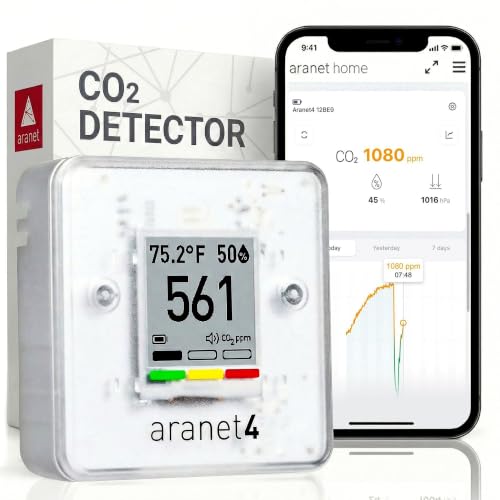
The reference CO2 meter many ventilation researchers carry: an NDIR sensor, a crisp e-ink screen with a big CO2 number and a battery that lasts years, plus Bluetooth history in a free app.
- NDIR CO2, temperature, humidity, pressure
- E-ink display, colour indicator and optional buzzer
- Up to ~4 years on 2 AA batteries
- Bluetooth app with 90-day history
- ✅ Highly regarded CO2 accuracy
- ✅ Fully portable and cable-free
- ✅ Readable at a glance
- ❌ CO2 only — no particle or VOC sensing
- ❌ Pricey for a single-pollutant meter
- ❌ Bluetooth, not Wi-Fi
If the question you want answered is “does this room need fresh air?”, the Aranet4 is the sharpest tool for the job. CO2 is the best everyday proxy for ventilation: as people breathe in a closed room, it climbs steadily, and high levels go hand in hand with stuffiness, headaches and poor focus. The Aranet4 uses a nondispersive infrared (NDIR) sensor — the type that actually measures CO2 rather than estimating it from other gases — and owners and researchers alike regard its readings as dependable.
The design is thoughtful. The e-ink display shows a big CO2 number with a green, amber or red indicator, it runs for years on two AA batteries, and the free Bluetooth app stores roughly 90 days of history so you can see exactly when the bedroom crossed 1,000 ppm overnight. It’s small enough to carry between rooms or take on trips, which is how many people discover how stuffy hotel rooms and meeting rooms really are.
What it doesn’t do is just as important: there’s no particle, VOC or radon sensor. It’s a specialist. Pair it with a cheap PM2.5 monitor if you also care about smoke and dust, or choose the View Plus for everything in one box.
3. Best for Alexa Homes: Amazon Smart Air Quality Monitor


Amazon Smart Air Quality Monitor
A compact plug-in monitor for Alexa homes that reads PM2.5, VOCs, carbon monoxide, humidity and temperature, scores your air in the Alexa app and can trigger purifiers or fans through Routines.
- PM2.5, VOC, CO, humidity, temperature
- Colour LED status light; details in Alexa app
- Alexa announcements and Routines
- Plug-in USB power
- ✅ Low price for five sensors
- ✅ Easy Alexa automation
- ✅ Big owner base
- ❌ No screen with numbers
- ❌ No CO2 sensor
- ❌ Not a certified CO alarm
Amazon’s monitor is a small white cube that plugs into a USB charger and quietly tracks PM2.5, VOCs, carbon monoxide, humidity and temperature. Its own front panel is a colour light rather than a screen; the detail lives in the Alexa app, which turns the readings into an easy air quality score and history graphs. With more than 5,500 ratings averaging 4.2 stars, it’s the most widely owned monitor on this list.
The real reason to buy it is automation. You can ask any Echo speaker how the air is, get spoken announcements when it gets worse, and build Routines that switch on a smart plug, fan, dehumidifier or Alexa-compatible purifier when PM2.5 or humidity rises. For about $70 that’s a lot of capability.
Two limits to keep in mind: it doesn’t measure CO2, so it won’t tell you when a bedroom needs ventilating, and its CO reading is not a substitute for a certified, UL-listed carbon monoxide alarm. Treat it as a smart-home air sensor rather than a safety device.
4. Best All-in-One Screen: BREATHE Airmonitor Plus Gen 2

BREATHE Airmonitor Plus Gen 2
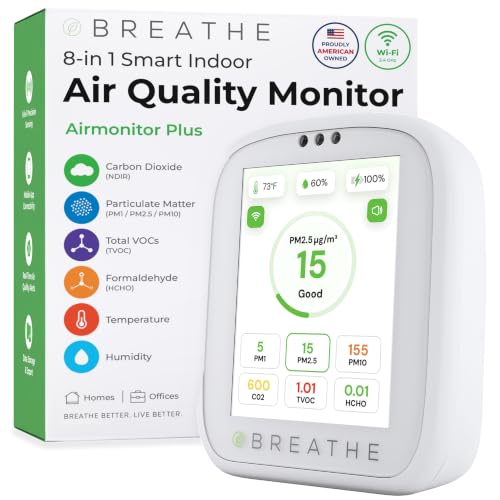
An 8-in-1 desktop monitor with a colour screen covering NDIR CO2, PM1/PM2.5/PM10, TVOC, formaldehyde, temperature and humidity, with Wi-Fi alerts, 90-day history and a few hours of battery for room-to-room checks.
- NDIR CO2, PM1/2.5/10, TVOC, HCHO, temp, humidity
- Colour display plus Wi-Fi app alerts
- 90-day history and data export
- Up to ~6 hours on battery
- ✅ Broad sensor list for about $100
- ✅ Real NDIR CO2 sensor
- ✅ Screen and app together
- ❌ VOC and formaldehyde readings are indicative
- ❌ Smaller brand
- ❌ Battery is for short spot checks
The Airmonitor Plus packs a lot onto one colour display: NDIR CO2, three particle sizes (PM1, PM2.5 and PM10), total VOCs, formaldehyde, temperature and humidity. For roughly the price of the Amazon monitor plus a cheap CO2 meter, you get both kinds of reading on a desktop screen you can glance at, with Wi-Fi alerts and 90 days of history in the companion app.
The Gen 2 model added a battery good for several hours, so you can carry it into the kitchen while cooking or into a freshly painted room to see what’s happening, then return it to its charging spot. Owners like the instant feedback; many describe watching PM2.5 spike when they fry food and drop again once the hood is on.
Keep realistic expectations for the VOC and formaldehyde numbers. Low-cost sensors for those gases react to many chemicals at once and are best treated as “something changed” indicators rather than lab-grade measurements, which is true of nearly every consumer monitor, not just this one.
5. Best for Basements and Radon: Airthings Wave Plus


Airthings Wave Plus Radon & Air Quality Monitor (2930)
A battery-powered disc that measures radon, CO2, VOCs, humidity, temperature and pressure; wave a hand for a colour status or open the Bluetooth app for full readings and trends.
- Radon, NDIR CO2, VOC, humidity, temp, pressure
- Wave-to-check colour light
- Runs on 2 AA batteries
- Bluetooth app; Wi-Fi via optional hub
- ✅ Proven radon accuracy
- ✅ Mounts anywhere without cables
- ✅ Long-established product
- ❌ No particle (PM2.5) sensor
- ❌ Bluetooth-only without a hub
- ❌ No screen with numbers
The Wave Plus is the older sibling of the View Plus and still one of the most trusted radon monitors you can buy. It reads radon, CO2, VOCs, humidity, temperature and pressure, runs on two AA batteries for a long time, and mounts flat on a wall or ceiling, which makes it ideal for a basement, a ground-floor bedroom or a crawl-space room where there’s no convenient socket.
A hand wave produces a colour status light; full numbers and trends live in the Bluetooth app, or online through an optional Airthings hub. It has more than 3,200 ratings, and its radon readings are widely respected.
It lacks a particle sensor, which is the main reason it sits below the View Plus. If you already own a PM2.5 monitor or a purifier with its own sensor, the Wave Plus is the more affordable route to continuous radon and CO2 tracking.
6. Best Handheld Analyzer: Temtop M2000


Temtop M2000 Air Quality Analyzer & CO2 Monitor
A handheld analyzer built around a SenseAir NDIR CO2 sensor, a laser particle sensor and a Dart formaldehyde sensor, with adjustable alarms, USB data export and a rechargeable battery for portable checks.
- NDIR CO2, PM2.5, PM10, particle counts, HCHO, temp, humidity
- Adjustable audio alarm and colour levels
- USB data export; calibration routine
- Rechargeable battery, carry case
- ✅ Respected sensor components
- ✅ Good for spot-checking rooms and renovations
- ✅ Data export for records
- ❌ No Wi-Fi app
- ❌ Bulkier than desktop monitors
- ❌ Pricey
The M2000 feels more like a measuring instrument than a gadget. It’s built around a SenseAir NDIR CO2 sensor, a laser particle counter that reports PM2.5, PM10 and particle counts, and a Dart electrochemical formaldehyde sensor — components with good reputations in the air-testing world. A rechargeable battery and carry case make it easy to walk from room to room and compare.
That portability is its strength. It’s the monitor to use after new flooring, cabinetry or a mattress arrives, when you want to see whether formaldehyde levels fall over the following weeks. Adjustable alarms beep when a threshold is crossed, and USB data export lets you keep records or share them with a contractor or landlord.
It has no Wi-Fi or app, so it isn’t a set-and-forget home monitor, and it costs more than desktop units with similar sensor lists. Choose it if you value measurement quality and portability over smart features.
7. Best Budget PM2.5 Monitor: GoveeLife H5106


GoveeLife Smart Air Quality Monitor H5106
A low-cost Wi-Fi PM2.5 monitor with a bright LED readout, humidity and temperature, that can switch GoveeLife purifiers, humidifiers and heaters on automatically.
- PM2.5 (±15 µg/m³), temperature, humidity
- LED number display with night mode
- Wi-Fi app; automates GoveeLife appliances
- Wired power
- ✅ Very affordable
- ✅ Clear numeric PM2.5 display
- ✅ Handy purifier automation
- ❌ Only PM2.5 — no CO2 or VOC
- ❌ Needs to stay plugged in
- ❌ Automation limited to GoveeLife devices
Fine particles are the pollutant most closely tied to health effects, and the GoveeLife H5106 is the cheapest sensible way to watch them. It shows a large PM2.5 number alongside temperature and humidity, refreshes quickly, and has a four-level colour indicator plus a night mode so it doesn’t light up the bedroom.
It connects over Wi-Fi to the Govee Home app for history and alerts, and if you own GoveeLife purifiers, humidifiers or heaters, it can switch them on and off automatically based on the readings. During wildfire season that alone is worth the price.
The trade-offs: it measures only particles (no CO2 or VOCs) and must stay plugged in. For a full picture, pair it with the Temtop CO2 meter below — together they cost about $70.
8. Best Cheap CO2 Meter: Temtop Portable CO2 Monitor


Temtop Portable CO2 Monitor
A pocket-size CO2 meter with an NDIR-type sensor, temperature and humidity readings, an audible alert and weeks of battery life — a cheap way to see when a bedroom or office needs fresh air.
- CO2 400–5,000 ppm, temperature, humidity
- CO2 sensor rated ±40 ppm +5% (400–2,500 ppm)
- Rechargeable; long standby
- Silent mode and display-off option
- ✅ Real CO2 sensing for about $30
- ✅ Small enough to carry
- ✅ Night-friendly settings
- ❌ No app or history
- ❌ CO2 only
- ❌ Small screen
For around $30, this pocket-sized Temtop puts real CO2 sensing within anyone’s reach. It reads from 400 to 5,000 ppm with stated accuracy of ±40 ppm plus 5% in the normal indoor range, shows temperature and humidity, and can sound an alert when levels climb. Its battery standby time runs to weeks, and you can silence the buzzer and dim the screen for bedroom use.
There’s no app or history, so you won’t see overnight graphs, and the screen is small. But as a simple “open the window now” signal in a bedroom, nursery or home office, it does the important part of an Aranet4’s job for a fraction of the price.
Comparison Table
| Product | Price Tier | Rating | Best For | Amazon |
|---|---|---|---|---|
| Airthings View Plus Radon & Air Quality Monitor (2960) | Premium | 4.0/5 | Whole-home monitoring, basements and families who want one device | Check Price |
| Aranet4 Home CO2 Monitor | Mid-range | 4.7/5 | Bedrooms, home offices, classrooms and travel | Check Price |
| Amazon Smart Air Quality Monitor | Budget | 4.2/5 | Alexa and Echo households that want automation | Check Price |
| BREATHE Airmonitor Plus Gen 2 | Budget–mid | 4.0/5 | People who want every reading on one screen for about $100 | Check Price |
| Airthings Wave Plus Radon & Air Quality Monitor (2930) | Premium | 4.2/5 | Radon checks in basements and ground floors without outlets | Check Price |
| Temtop M2000 Air Quality Analyzer & CO2 Monitor | Mid-range | 4.3/5 | Renovations, new furniture, spot checks and DIY investigators | Check Price |
| GoveeLife Smart Air Quality Monitor H5106 | Budget | 4.3/5 | Smoke, cooking and wildfire-season tracking on a budget | Check Price |
| Temtop Portable CO2 Monitor | Budget | 4.3/5 | Kids’ rooms, small offices and anyone curious about ventilation | Check Price |
How Do These Air Quality Monitors Compare?
The Airthings View Plus covers the most important pollutants, including radon and PM2.5. The Aranet4, Temtop M2000 and BREATHE use true NDIR CO2 sensors; Amazon’s and GoveeLife’s monitors skip CO2 entirely. Pick by the pollutants you care about first, then by display, app and power.
| Model | PM2.5 | CO2 | Radon | VOC / HCHO | Screen | Connectivity | Rating | Amazon |
|---|---|---|---|---|---|---|---|---|
| Airthings View Plus | Yes | NDIR | Yes | VOC | E-ink | Wi-Fi | 4.0★ | Check price |
| Aranet4 Home | No | NDIR | No | No | E-ink | Bluetooth | 4.7★ | Check price |
| Amazon Smart AQM | Yes | No | No | VOC (+CO) | LED light | Wi-Fi / Alexa | 4.2★ | Check price |
| BREATHE Airmonitor Plus | Yes (+PM1/PM10) | NDIR | No | Both | Colour | Wi-Fi | 4.0★ | Check price |
| Airthings Wave Plus | No | NDIR | Yes | VOC | Light only | Bluetooth | 4.2★ | Check price |
| Temtop M2000 | Yes (+PM10) | NDIR | No | HCHO | Colour | USB export | 4.3★ | Check price |
| GoveeLife H5106 | Yes | No | No | No | LED digits | Wi-Fi | 4.3★ | Check price |
| Temtop Portable CO2 | No | Yes | No | No | LCD | None | 4.3★ | Check price |
Sensor lists, ratings and prices come from Amazon listings and manufacturer pages checked in October 2026. Accuracy claims are the makers’. Prices change often, so check the current price before buying.
Which Air Quality Sensors Actually Matter?
The four readings worth paying for are PM2.5 (fine particles from smoke, cooking and dust), CO2 measured by an NDIR sensor (ventilation), radon (if you have a basement or live in a radon-prone area) and humidity. VOC and formaldehyde sensors are useful trend indicators but far less precise.
PM2.5 are particles small enough to reach deep into the lungs. Consumer monitors measure them with a small laser and fan, and good ones track real changes well — you’ll see the number jump when you toast bread and fall when a purifier runs. CO2 shows how well a room is ventilated. The key is the sensor type: NDIR sensors measure CO2 directly, while some cheap units display an “eCO2” value calculated from a VOC sensor, which can be badly wrong. If a listing doesn’t say NDIR or photoacoustic, assume the CO2 number is an estimate.
Radon is a radioactive gas from soil that can build up in lower floors. The EPA recommends fixing a home at 4 pCi/L or above. Only dedicated radon sensors, like the ones in Airthings monitors, can detect it. VOCs (volatile organic compounds) come from paints, cleaners, cooking and furniture. Consumer VOC sensors respond to a mix of gases and report a relative index, so watch the trend rather than the absolute figure. Humidity is simple but important: too high encourages dust mites and mould, too low dries out skin and sinuses.
For a deeper look at each sensor, read what do air quality monitors measure.
What Do Air Quality Monitor Readings Mean?
As a rough guide, keep indoor CO2 under about 800–1,000 ppm, PM2.5 as close to single digits as you can (under 12 µg/m³ is good, over 35 is poor), humidity between 30% and 50%, and radon below the EPA action level of 4 pCi/L — ideally under 2.
| Reading | Good | Take action | What usually fixes it |
|---|---|---|---|
| CO2 | Under ~800 ppm | Over ~1,000–1,500 ppm | Open windows, run ventilation, fewer people per room |
| PM2.5 | 0–12 µg/m³ | Over ~35 µg/m³ | Range hood, HEPA purifier, close windows during smoke events |
| Humidity | 30–50% | Under 25% or over 60% | Humidifier or dehumidifier, bathroom fans |
| Radon | Under 2 pCi/L | 4 pCi/L or higher (long-term average) | Professional radon mitigation system |
| VOC index | Low / stable | Sustained high readings | Ventilate, remove the source, store chemicals outside |
Thresholds summarise widely used guidance (including EPA advice on radon and humidity) and common ventilation targets. They’re general guides, not medical advice.
Short spikes are normal. CO2 will rise while you sleep with the door shut, and PM2.5 will jump when you cook. What matters is how high levels go, how long they stay there, and whether they come back down. That pattern tells you where to put your effort, as covered in how to monitor air quality at home.
How Do You Choose an Air Quality Monitor?
Start with the problem you want to solve: stuffiness and sleep (CO2), smoke, dust and cooking (PM2.5), basement safety (radon), or renovation fumes (formaldehyde/VOC). Then choose a true NDIR CO2 sensor if CO2 is on the list, decide between a screen and an app, and pick battery or plug-in power to suit where it will live.
- Match sensors to your worries. Wildfire region or gas stove? Prioritise PM2.5. Tight, energy-efficient home or kids sharing a bedroom? Prioritise CO2. Basement or radon zone? You need a radon sensor.
- Check the CO2 sensor type. Look for “NDIR” or “photoacoustic” in the specs.
- Screen or app? A visible number nudges you to act; an app gives history, alerts and automation. The best monitors have both.
- Power. Battery units (Aranet4, Airthings) can go anywhere; particle sensors use a fan and usually need constant power or frequent charging.
- Smart home. Alexa users get the most from Amazon’s monitor; GoveeLife owners from the H5106; Airthings works with several platforms.
- Running costs. None of these need subscriptions for basic use, but sensors do age — see how long air quality monitors last.
If you’re still deciding whether a monitor is worth it at all, our guide on why you should have an air quality monitor walks through who benefits most.
Can an Air Quality Monitor Detect Mold or Carbon Monoxide?
No consumer monitor can directly detect mould spores. What they can do is warn you about the conditions mould needs — humidity that stays above about 60% — and some VOC sensors react to the musty gases growing mould gives off. For carbon monoxide, rely on a certified CO alarm, not an air quality monitor.
A few monitors, including Amazon’s, include a CO sensor, but they’re not tested and listed as life-safety alarms, so they don’t replace one on each level of your home. For mould, humidity tracking is the most useful thing a monitor offers; we explain how to use it in do air quality monitors detect mold.
Where Should You Put an Air Quality Monitor?
Place it in the room you spend the most time in — usually the bedroom or living room — at roughly breathing height, a few feet away from windows, vents, the kitchen stove and people’s faces. For radon, put a monitor on the lowest lived-in floor, away from drafts.
- Bedroom: on a dresser or shelf a few feet from the bed, not right beside your pillow, where your breath inflates CO2 readings.
- Living area: mid-room at about 3–6 feet high, away from direct sun and heating vents.
- Kitchen: nearby rather than next to the hob, so it reflects what you breathe instead of raw cooking plumes.
- Basement: for radon, about 20 inches or more off the floor and clear of sump pits, windows and exterior doors.
If you own only one monitor, move it around for a week at a time. You’ll quickly learn which room has the worst air and where a permanent monitor or purifier would help most.
Do Air Quality Monitors Need Calibration?
Most NDIR CO2 monitors calibrate themselves automatically by assuming the lowest reading over a period equals outdoor air, or offer a manual “fresh air” calibration you can run outdoors. Particle and VOC sensors are factory calibrated and can’t usually be recalibrated at home; if readings drift badly, the sensor may need replacing.
To sanity-check a CO2 monitor, take it outside for 10–15 minutes away from traffic and people; it should read around 420 ppm. If a particle sensor reads high in clean air or stops responding to obvious smoke, contact the maker. Avoid spraying cleaners, perfume or alcohol near the monitor, because these can confuse VOC sensors for hours.
Is an Expensive Air Quality Monitor Better Than a Cheap One?
Usually, yes — but only for the sensors you need. Expensive monitors justify their price with NDIR CO2 sensors, radon detection, better apps and longer support. A $30 NDIR CO2 meter and a $40 PM2.5 monitor will tell you more useful things than a $60 “16-in-1” gadget full of estimated readings.
Be wary of very cheap monitors advertising long lists of pollutants with large screens and few reviews. Many use a single low-cost VOC sensor to estimate CO2, formaldehyde and “AQI” all at once, so the numbers move together and mean little. Brands that publish their sensor makers and accuracy ranges, like Aranet, Airthings and Temtop, give you more to trust.
Final Verdict: Which Air Quality Monitor Should You Buy?
The Airthings View Plus is the best air quality monitor for most homes because it covers radon, particles, CO2 and VOCs in one well-designed device. Choose the Aranet4 if ventilation is your main concern, the Amazon Smart Air Quality Monitor for Alexa automation, the BREATHE Airmonitor Plus for a full screen of readings at a mid price, or pair the GoveeLife H5106 with the Temtop CO2 meter for a two-device setup under $75.
| If you want… | Choose | Link |
|---|---|---|
| One monitor for everything | Airthings View Plus | View on Amazon |
| Trustworthy CO2 readings | Aranet4 Home | View on Amazon |
| Alexa automation | Amazon Smart AQM | View on Amazon |
| Many readings on one screen | BREATHE Airmonitor Plus | View on Amazon |
| The lowest cost | GoveeLife H5106 + Temtop CO2 | View on Amazon |
Frequently Asked Questions
What is the most accurate home air quality monitor?
For CO2, monitors with NDIR sensors such as the Aranet4 are widely regarded as the most accurate consumer options. For radon, Airthings monitors have a strong track record. No single consumer monitor is lab-grade for every pollutant.
Are cheap air quality monitors accurate?
Cheap PM2.5 monitors track changes reasonably well. Cheap CO2 readings are only trustworthy if the unit uses an NDIR or photoacoustic sensor; many budget multi-sensor units estimate CO2 from a VOC sensor.
What should I look for in an indoor air quality monitor?
Choose sensors that match your concerns — PM2.5, NDIR CO2, radon or humidity — then consider display, app, power and smart-home support.
Do I need an air quality monitor if I have an air purifier?
A monitor shows whether the purifier is working and when to run it harder. It also measures CO2 and humidity, which purifiers don’t fix.
Can an air quality monitor replace a carbon monoxide detector?
No. Use a certified, UL-listed carbon monoxide alarm on every level of your home, even if your monitor has a CO sensor.
Which air quality monitor detects radon?
Airthings View Plus, Wave Plus and other dedicated radon monitors detect radon. Most general air quality monitors do not.
Where is the best place to put an air quality monitor?
In the room you use most, at breathing height, away from windows, vents, the stove and direct sunlight. For radon, use the lowest lived-in floor.
Do air quality monitors need Wi-Fi?
No. Many work standalone with a screen. Wi-Fi adds remote alerts, history and automation.