

How to Hang a Heavy Mirror on the Wall Safely
Last updated: November 12, 2026 · Product details checked on Amazon.com
Quick answer: To hang a heavy mirror, first weigh it, then locate wall studs with a stud finder. Screw heavy-duty hooks or a French cleat into at least one stud, or use anchors rated well above the mirror’s weight where studs aren’t available. Attach two D-rings or a cleat to the back of the mirror rather than relying on a single wire, check it’s level, and hang it with a helper. Always use hardware rated for at least twice the mirror’s weight.
A large mirror can transform a room, making it brighter and feeling bigger. But heavy mirrors, often 30 to 100 pounds or more, can cause serious injury and damage if they fall. Most failures happen because the hardware wasn’t rated for the weight, the anchor wasn’t suited to the wall type, or the mirror hung from a single point that worked loose. With the right preparation and hardware, hanging a heavy mirror securely is a straightforward DIY job.
This guide explains how to weigh your mirror, choose the right hanging method, find studs, use anchors in drywall and plaster, hang on masonry and tile, and set the right height.
What You’ll Need
You’ll need a bathroom scale, stud finder, tape measure, pencil, level, drill with bits, screwdriver, painter’s tape, and hanging hardware rated for your mirror’s weight: heavy-duty picture hooks, D-rings, braided wire, a French cleat or a Z-bar, plus wall anchors if you can’t hit studs. A helper makes lifting and positioning safer.
A good stud finder takes the guesswork out of locating framing and many models also detect live electrical wires, which helps you avoid drilling into cables.


Franklin Sensors ProSensor M210 Stud Finder
13-sensor stud finder that lights up the full width of a stud at once and flags live AC wires.
- 13 sensors
- Shows stud edges and centre
- Live wire warning
- Up to 1.5 in depth
- ✅ Very accurate
- ✅ No calibration
- ✅ Wire detection
- ❌ Needs a flat wall surface
Step 1: Weigh the Mirror
Stand on a bathroom scale and note your weight, then step on again holding the mirror and subtract the difference. Knowing the exact weight lets you choose hardware rated for at least twice that amount, which provides a safety margin for vibration, doors slamming and the occasional knock.
Step 2: Choose a Hanging Method
For heavy mirrors, the strongest options are a French cleat or Z-bar, two D-rings hung on two separate hooks, or D-rings with heavy-duty braided wire across two hooks. Cleats spread the load along their length and keep the mirror flat against the wall. Avoid a single nail or a single sawtooth hanger for anything heavy.
Many heavy mirrors arrive with D-rings already attached. Check that they’re screwed into solid wood, not just the thin backing board, and that they’re rated for the weight.
Step 3: Find the Studs
Run the stud finder horizontally across the wall at the height you’ll hang the mirror. Mark the edges and centre of each stud with a pencil. Studs are typically 16 inches apart in North American homes, sometimes 24 inches. Screwing into a stud gives the strongest hold for heavy mirrors.
Confirm a stud by drilling a small pilot hole: you’ll feel firm resistance and see wood shavings. If the bit suddenly goes through with no resistance, you’ve missed the stud.
Step 4: Mark the Hanging Points
Measure the distance from the top of the mirror to the hanging hardware when it’s pulled taut. Decide where the top of the mirror should sit, then measure down to mark where the hooks or cleat go. Use painter’s tape on the wall to mark the outline and check the position before drilling.
A paper template the size of the mirror, taped to the wall, makes it easy to visualise the placement and mark hook positions exactly.
Step 5: Install the Hardware
Where hanging points line up with studs, drill pilot holes and drive screws or hooks directly into the stud. Where they don’t, install heavy-duty anchors such as toggle bolts or snap toggles rated for the load. Use a level to make sure two hooks or a cleat are perfectly horizontal.
Spreading the load across two points, ideally at least one in a stud, gives a much stronger, more stable hang than a single central hook.
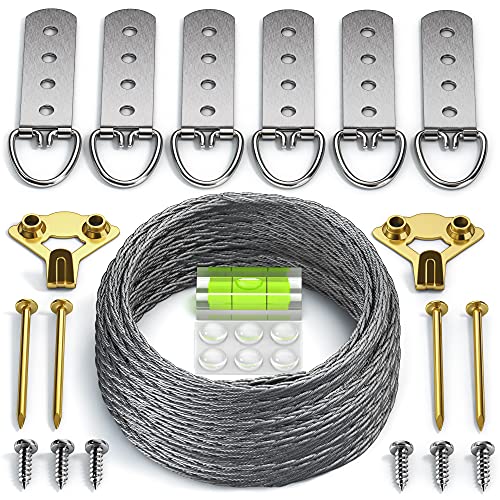

Heavy Duty Picture & Mirror Hanging Kit
Complete kit with D-rings, braided wire, heavy-duty hooks, screws and a small level for mirrors up to about 100 lb.
- D-rings and wire
- Heavy-duty hooks
- Screws and anchors
- Mini level
- ✅ Everything in one box
- ✅ Rated for heavy frames
- ✅ Includes level
- ❌ Check each part’s rating
Comparison Table
| Product | Price Tier | Rating | Best For | Amazon |
|---|---|---|---|---|
| Franklin Sensors ProSensor M210 Stud Finder | Mid-range | 4.6/5 | Locating studs and wires | Check Price |
| Heavy Duty Picture & Mirror Hanging Kit | Budget | 4.6/5 | Complete heavy-mirror setup | Check Price |
Step 6: Hang the Mirror
With a helper, lift the mirror by its frame, guide the wire, D-rings or cleat onto the wall hardware and lower it gently into place. Check it’s level, adjust if needed, and give it a gentle tug to confirm it’s secure. Add felt or rubber bumpers to the bottom corners to keep it from shifting and to protect the wall.
Best Anchors for Drywall
For heavy mirrors on drywall without a stud, use toggle bolts, snap toggles or heavy-duty metal hollow-wall anchors rated for the weight. These spread behind the drywall and grip strongly. Avoid plastic expansion anchors and adhesive hooks for heavy mirrors; they can pull out under sustained weight.
Always check the anchor package rating and remember it’s tested under ideal conditions. A large margin of safety is wise, especially in high-traffic areas or above furniture where people sit.
How to Hang a Mirror on Plaster Walls
Plaster can crack if you hammer nails into it. Place painter’s tape over the spot, drill a pilot hole slowly with a masonry or sharp drill bit, then install a screw into a stud or lath, or use a toggle bolt designed for plaster. Avoid simple nails and plastic anchors in old plaster walls.
How to Hang a Mirror on Brick or Tile
For brick or concrete, drill into the mortar or masonry with a masonry bit and use masonry anchors or sleeve anchors rated for the weight. For tile, use a tile or glass bit, apply painter’s tape to prevent slipping, drill slowly without hammer action, then insert appropriate anchors into the wall behind the tile.
How High Should You Hang a Heavy Mirror?
In open wall space, aim for the centre of the mirror to sit at roughly average eye level, about 57 to 60 inches from the floor. Above a console, dresser or sofa, leave 6 to 10 inches between the furniture and the bottom of the frame. In a bathroom, the top of the mirror usually lines up with the top of nearby door frames or lights.
Full-length floor mirrors can lean against the wall, but they should still be secured with a discreet anti-tip strap or bracket at the top, especially in homes with children and pets. A mirror that’s hung too high feels disconnected from the room, while one that’s too low may be bumped by furniture or knocked by people walking past.
Using a French Cleat for Very Heavy Mirrors
A French cleat is two interlocking strips with angled edges. One strip is screwed to the back of the mirror, the other to the wall, ideally into two or more studs. The mirror slides down onto the wall strip and locks in place. Cleats spread weight along their full length, keep the mirror flush, and make levelling simple.
Aluminium Z-bar cleats are thin and easy to install, while wooden cleats can be cut to any length. Make sure the screws on the mirror side go into the solid frame, not into thin backing board or MDF, which can tear out under load. For very large or ornate mirrors over 100 pounds, consider a professional installer.
Hanging a Frameless Mirror
Frameless mirrors are hung with special mirror clips, J-channels or mirror mastic adhesive designed for glass. Clips hold the edges top and bottom, while a J-channel supports the bottom edge along its length. Never use regular construction adhesive, which can damage the mirror’s silver backing.
For bathroom vanity mirrors, a combination of a bottom J-channel and top clips is common. Large frameless wall mirrors are heavy and fragile, so professional installation is often worthwhile.
Safety Tips
Always use hardware rated for at least twice the mirror’s weight, check for pipes and wires before drilling, wear safety glasses, have a helper lift large mirrors, and avoid hanging heavy mirrors above beds or cribs. Check hardware periodically for loosening, especially in homes with vibration from doors or traffic.
Safety film on the back of a mirror holds glass fragments together if it ever breaks. Many modern mirrors include it, but it can be added to older ones for extra peace of mind.
Common Mistakes When Hanging Heavy Mirrors
The most frequent mistakes are guessing the mirror’s weight, using a single nail or sawtooth hanger, relying on plastic anchors, attaching D-rings only to thin backing board, skipping the level, and lifting a large mirror alone. Each of these increases the risk of the mirror slipping, tilting or falling.
Another common error is hanging the mirror from a wire that has too much slack. When the wire is loose, the mirror leans forward and puts extra leverage on the hooks. Pull the wire to about 2–3 inches below the top of the frame, or switch to two D-rings for a flatter, more secure hang. Our guide on how to hang pictures without damage covers lighter frames and renter-friendly options.
Can You Hang a Heavy Mirror Without Drilling?
For truly heavy mirrors, drilling into studs or using proper anchors is the only safe option. Adhesive strips and no-drill hooks are designed for light frames only. Renters can lean a large floor mirror against the wall with an anti-tip strap, or ask the landlord about installing proper hardware.
Hanging a Mirror in a Bathroom
Bathroom mirrors face humidity, so use stainless or rust-resistant screws and hooks. Centre the mirror over the sink, leave space for lights and taps, and allow a gap behind the frame for air to circulate so moisture doesn’t damage the backing. Keep the surface sparkling with our guide on how to clean a bathroom mirror.
Bottom Line: How to Hang a Heavy Mirror
Weigh the mirror, find studs, and use two hanging points or a French cleat with hardware rated for at least twice the weight. Use toggle bolts or heavy-duty anchors where studs aren’t available, check everything is level, and lift with a helper. Done properly, a heavy mirror will stay safely in place for years.
Frequently Asked Questions
What is the best way to hang a heavy mirror?
Use two points or a French cleat screwed into studs, with hardware rated for twice the weight.
Can drywall hold a heavy mirror?
Yes, with toggle bolts or heavy-duty anchors rated for the weight.
What height is right for a wall mirror?
Most people place the mirror’s middle roughly at eye level, about 5 feet up, or leave a 6–10 inch gap above a console or sofa.
Can I use Command strips for a heavy mirror?
No, adhesive strips aren’t suitable for heavy mirrors.
Should a heavy mirror be hung with wire or D-rings?
Two D-rings on two hooks or a cleat are more secure than one wire.
How much weight can a stud hold?
A screw in a stud can hold well over 100 lb when installed correctly.