
Best Whole House Water Filter: 8 Systems for Cleaner Water From Every Tap
Last updated: October 13, 2026 · Product details checked on Amazon.com
Quick answer: For most homes on city water, the best whole house water filter is the Express Water Ultimate Protection 3-stage system: it pairs sediment, carbon and heavy-metal media with anti-scale protection on a sturdy frame with pressure gauges. Choose the iSpring WGB32B for high flow in larger homes, the Aquasana Rhino or A. O. Smith tank if you want years between main-filter changes, the iSpring WGB21B on a budget, or the Aquasana Well Water + UV system for private wells. Test your water first so you buy for the problem you actually have.
Top Picks at a Glance
| Best overall | Express Water Ultimate 3-Stage — chlorine, metals and scale |
| Best for large homes | iSpring WGB32B — 20″ filters, up to 15 GPM |
| Best long-life tank | Aquasana Rhino EQ-1000 — 1 million gallons |
| Best value tank | A. O. Smith 600K — six-year central filter |
| Best budget | iSpring WGB21B — 2-stage, 4,200+ ratings |
| Best compact 2-stage | Waterdrop WHF21-PG — lead-free certified parts |
| Best sediment-only | GE GXWH40L — clear sump, reminder light |
| Best for well water | Aquasana Well Water + UV — UV and scale control |
A whole house water filter — also called a point-of-entry system — sits on the main water line where it enters your home, so every faucet, shower, washing machine and water heater gets filtered water. That’s very different from a pitcher or under-sink filter, which only treats water at one tap.
Done right, a whole house system takes the chlorine smell out of showers, stops sediment clogging aerators and appliance valves, and can reduce scale on fixtures. Done wrong — for example, buying a carbon filter when your real problem is hard water or iron — it’s an expensive box that doesn’t fix anything. This guide compares eight well-reviewed systems and, just as importantly, explains how to match a system to your water.
How We Chose These Systems
No manufacturer paid for placement and we didn’t receive free units. In October 2026 we compared each system’s Amazon listing and manufacturer specifications — stages and media, cartridge size, rated capacity, flow rate, port size, certifications and what the system does not remove — and recorded ratings and review counts. We also noted the limits each maker states, such as what the media can’t remove and how often filters need changing. We haven’t lab-tested these systems ourselves, so we report certifications exactly as the makers state them.
What Should You Know Before Buying a Whole House Water Filter?
Find out what’s in your water before you choose a filter. City water customers can read their utility’s annual water quality report (Consumer Confidence Report); well owners should get a certified lab test. Then pick a system that targets those specific issues — chlorine, sediment, hardness, iron, metals or bacteria — rather than buying by stage count.
Whole house filters are not one-size-fits-all. A carbon system is excellent at chlorine taste and odor but won’t soften hard water. A water softener handles hardness but doesn’t remove chlorine. Well water may need iron removal or disinfection that a standard carbon filter can’t provide. In the US, your city’s water report lists detected contaminants each year, and many state health departments maintain lists of certified labs for private well testing.
- Chlorine or chloramine taste and smell: carbon filtration (most systems here).
- Sand, silt and rust particles: sediment pre-filter.
- Scale on fixtures and appliances: anti-scale media or a water softener — see whole house water filter vs water softener.
- Bacteria concerns on well water: testing first, then appropriate disinfection such as UV, with professional advice.
- Dissolved solids, nitrates or arsenic in drinking water: usually a point-of-use reverse osmosis system at the kitchen sink — compare in whole house filter vs reverse osmosis.
What Are the Best Whole House Water Filters?
Express Water’s Ultimate Protection 3-stage system is the best all-rounder for city water. iSpring’s WGB32B suits large homes that need high flow, Aquasana’s Rhino and A. O. Smith’s tank suit people who want rare main-filter changes, iSpring’s WGB21B and Waterdrop’s WHF21-PG are strong budget options, GE’s GXWH40L handles sediment, and Aquasana’s UV package is built for wells.
1. Best Overall: Express Water Ultimate Protection 3-Stage


Express Water Whole House Water Filter System, Ultimate Protection, 3-Stage
A three-stage system on a stainless steel frame, built to cut chlorine, reduce heavy metals and add polyphosphate anti-scale protection for the whole home.
- 3 stages: sediment, heavy-metal/carbon, anti-scale
- Stainless steel bracket and free-stand frame
- Pressure gauges and pressure-release buttons
- Targets chlorine, lead and scale (per manufacturer)
- ✅ Covers chlorine, metals and scale in one unit
- ✅ Gauges show when filters clog
- ✅ Sturdy frame simplifies mounting
- ❌ Three cartridges to replace
- ❌ Anti-scale is not a true water softener
Express Water’s Ultimate Protection system covers the three problems most city-water homes ask about: chlorine taste and smell, sediment, and scale. The first stage catches particles, the second uses carbon and heavy-metal media that the maker says reduces chlorine and metals such as lead, and the third adds polyphosphate, which helps keep scale from building up in pipes and appliances.
What sets this model apart is the hardware. It comes on a heavy-duty stainless steel bracket and free-standing frame, with a pressure gauge and pressure-release button for each housing. Watching the gauges tells you when a cartridge is clogging, so you replace filters based on real conditions rather than guesswork.
Keep expectations realistic: polyphosphate anti-scale isn’t a water softener. It slows scale formation but doesn’t remove hardness minerals, so homes with very hard water may still want a softener. With more than 2,700 ratings averaging 4.5 stars, it’s the most balanced system in this guide. Skip it if: your only issue is sediment — a single-stage GE system costs far less.
2. Best for Large Homes: iSpring WGB32B Commercial-Grade 3-Stage


iSpring WGB32B Commercial-Grade 3-Stage Whole House Water Filter
A big-blue 20-inch, three-stage system with a 5-micron sediment filter and two coconut-shell carbon blocks, rated up to 15 GPM for busy households.
- 20″ × 4.5″ cartridges, 1″ NPT ports
- Up to 15 GPM flow
- 5-micron sediment + 2 CTO carbon blocks
- About 100,000 gallons per set (≈1 year)
- ✅ Highest rating in this guide
- ✅ Strong flow for large homes
- ✅ Keeps beneficial minerals
- ❌ Large footprint
- ❌ Doesn’t soften water or remove TDS
Pressure drop is the most common complaint about whole house filters, especially in larger homes where several showers and appliances run at once. iSpring’s WGB32B uses big 20-inch by 4.5-inch cartridges and 1-inch ports, rated for up to 15 gallons per minute, so it’s less likely to choke your flow.
The three stages are a 5-micron sediment filter followed by two coconut-shell carbon blocks, which iSpring says were tested by a third party to NSF/ANSI standards and remove up to 99% of chlorine. A set of cartridges is rated for around 100,000 gallons, roughly a year for many families.
It’s the highest-rated system here at 4.7 stars from more than 2,200 owners. Like other carbon systems, it keeps minerals in the water — it won’t soften or lower TDS. iSpring itself points buyers who want TDS reduction toward reverse osmosis, which we cover in our best reverse osmosis system guide.
3. Best Long-Life Tank: Aquasana Rhino EQ-1000


Aquasana Rhino Whole House Water Filter, 1 Million Gallons, EQ-1000
A large carbon and KDF tank rated for 1 million gallons or about 10 years, with a pre-filter and post-filter you swap every couple of months.
- Tank rated for 1,000,000 gallons / ~10 years
- Activated carbon + KDF media
- 20″ pre-filter and post-filter
- Brass fittings for 1″ or 3/4″ pipes, shut-off valves
- ✅ Very long main-tank life
- ✅ No backflushing or draining
- ✅ Full install kit
- ❌ Higher upfront cost
- ❌ Pre-filter changes every ~2 months
Cartridge systems need new filters every few months to a year. Tank systems like Aquasana’s Rhino flip that: a large tank of activated carbon and KDF media is rated for 1 million gallons or about 10 years, with only a small pre-filter and post-filter to swap every couple of months.
Aquasana says the carbon reduces 97% of chlorine and that a redesigned divider valve keeps flow strong without a noticeable drop in pressure. There’s no backflushing or draining, and the kit includes brass fittings for 1-inch or 3/4-inch pipes, bend supports and shut-off valves.
The upfront price is higher and the 4.2-star rating from about 700 owners is lower than the cartridge picks. It doesn’t reduce TDS or soften water. If you value low maintenance over the long run, though, it’s one of the most established options.
4. Best Value Tank: A. O. Smith Whole House Filter, 600,000 Gallons


A. O. Smith Whole House Water Filter System, 600,000 Gallons
A single central filter tank that lasts up to six years or 600,000 gallons, aimed at reducing chlorine taste and odor across the home.
- Central filter: 6 years / 600,000 gallons
- Reduces chlorine taste & odor
- No backflushing or water waste
- 6-year limited warranty
- ✅ Set-and-forget tank
- ✅ Long warranty
- ✅ No drain line needed
- ❌ Doesn’t treat TDS, sulfur or iron
- ❌ Pre-filter recommended (sold separately)
A. O. Smith’s central filter is a simpler, more affordable take on the tank idea. One tank lasts up to six years or 600,000 gallons, reduces 96.9% of chlorine taste and odor according to the manufacturer, and comes with a six-year limited warranty. Like the Aquasana, it needs no drain line or backflushing.
A. O. Smith is clear about its limits: it doesn’t soften water and won’t reduce TDS, sulfur or iron, and the company recommends adding a pre-filter to protect the tank from sediment. With nearly 2,000 ratings at 4.3 stars, it’s a solid choice for city water where chlorine is the main complaint. For well-specific advice, see our best water filter for well water guide.
5. Best Budget: iSpring WGB21B 2-Stage
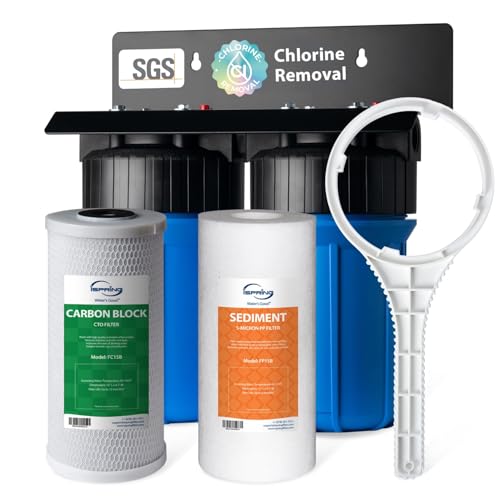

iSpring WGB21B 2-Stage Whole House Water Filtration System
A compact two-stage system — 5-micron sediment plus a coconut-shell carbon block — that comes pre-assembled on its bracket.
- 10″ × 4.5″ cartridges, 1″ ports
- 5-micron sediment + CTO carbon
- Up to ~50,000 gallons (about a year for 4)
- Pre-assembled with wrench and pressure-release valve
- ✅ Most-reviewed system here
- ✅ Easy DIY install
- ✅ Low running cost
- ❌ Smaller cartridges than 20″ systems
- ❌ No heavy-metal or scale stage
If you want to start simply, iSpring’s WGB21B is the most-reviewed system in this guide with more than 4,200 ratings averaging 4.6 stars. It pairs a 5-micron polypropylene sediment filter with a coconut-shell carbon block in standard 10-inch by 4.5-inch housings, rated for up to about 50,000 gallons — roughly a year for a family of four.
It ships pre-assembled on its mounting bracket with a filter wrench and pressure-release valve, which makes DIY installation easier. The trade-off is smaller cartridges than 20-inch systems, so flow and capacity are lower in big homes, and there’s no dedicated heavy-metal or anti-scale stage.
6. Best Compact 2-Stage: Waterdrop WHF21-PG


Waterdrop WHF21-PG 2-Stage Whole House Water Filter System
A two-stage sediment and granular carbon system whose cartridges meet NSF/ANSI 372 lead-free material standards, with chlorine reduction tested to NSF/ANSI 42 by SGS.
- 10″ × 4.5″ PP sediment + GAC carbon
- 5-micron sediment filtration
- Carbon change ~6 months, sediment 3–6 months
- Wrench included for DIY install
- ✅ Good chlorine reduction for the price
- ✅ Third-party tested
- ✅ Simple layout
- ❌ Lab testing, not full NSF certification
- ❌ Shorter cartridge life than 20″ systems
Waterdrop’s two-stage system combines a 5-micron PP sediment filter and a granular activated carbon filter. Waterdrop reports SGS testing to NSF/ANSI 42 methods showing up to 95.6% free chlorine reduction, and both cartridges meet NSF/ANSI 372 lead-free material standards, which concern the materials used in the product rather than lead removal from water.
The carbon cartridge typically lasts around six months and the sediment filter three to six months, depending on your water. It’s a tidy, affordable system with a wrench included and 1,500-plus ratings averaging 4.4 stars. Note the distinction between lab testing to a standard and full certification by an organization such as NSF or WQA when comparing claims.
7. Best Sediment-Only: GE GXWH40L


GE GXWH40L Whole House Water Filtration System
A single-stage housing with a clear sump and a filter-change reminder light, certified to reduce sediment, scale, dirt and rust.
- Single stage, 1″ plumbing connection
- Clear sump to see the filter
- Pressure relief valve, bypass, reminder light
- Filters FXHTC/FXHSC every 3 months (sold separately)
- ✅ Simple, inexpensive entry point
- ✅ See when the filter is dirty
- ✅ Brand-name support
- ❌ One stage only
- ❌ Filter not included; 3-month changes
Sometimes the problem is simply particles: sand, silt and rust flakes that clog aerators, showerheads and appliance valves. GE’s GXWH40L is a single heavy-duty housing with a clear sump, so you can see when the filter is dirty, plus a filter-change reminder light, pressure-relief valve and bypass.
GE says the system is certified to reduce sediment, scale, dirt and rust. Filters (FXHTC or FXHSC) aren’t included and should be replaced about every three months. Note that the housing is designed for horizontal pipe connections. It’s also a good first stage ahead of a carbon tank like the A. O. Smith.
8. Best for Well Water: Aquasana Whole House Well Water Filter + UV


Aquasana Whole House Well Water Filter with UV, 500,000 Gallons
A well-water package combining carbon and KDF filtration, salt-free scale control and a UV unit certified to NSF/ANSI 55 Class B.
- 500,000 gallons / ~5 years
- Carbon + KDF + salt-free scale control
- UV certified to NSF/ANSI 55, Class B
- Best under 15 gpg hardness
- ✅ Adds UV for well water
- ✅ No salt or backwashing
- ✅ 5-year limited warranty
- ❌ Premium price
- ❌ Does not soften or remove iron
Well water comes with different risks from city water, and it’s the owner’s responsibility to test it. Aquasana’s well package combines pre- and post-filters, carbon and KDF media, a salt-free scale-control stage and a UV unit, rated for 500,000 gallons or about five years with a five-year limited warranty.
The UV unit is certified to NSF/ANSI 55 Class B. That class is designed for supplemental treatment of water that’s already considered safe — reducing nuisance organisms — rather than for disinfecting water known to be contaminated, so a lab test and local health guidance still come first. The scale stage works best below 15 grains per gallon of hardness, and the system doesn’t soften water or remove iron.
Comparison Table
| Product | Price Tier | Rating | Best For | Amazon |
|---|---|---|---|---|
| Express Water Whole House Water Filter System, Ultimate Protection, 3-Stage | Mid-range | 4.5/5 | City water with chlorine and scale concerns | Check Price |
| iSpring WGB32B Commercial-Grade 3-Stage Whole House Water Filter | Mid-range | 4.7/5 | Bigger households with several bathrooms | Check Price |
| Aquasana Rhino Whole House Water Filter, 1 Million Gallons, EQ-1000 | Premium | 4.2/5 | Owners who want years between main-filter changes | Check Price |
| A. O. Smith Whole House Water Filter System, 600,000 Gallons | Mid-range | 4.3/5 | Chlorine taste and odor with minimal upkeep | Check Price |
| iSpring WGB21B 2-Stage Whole House Water Filtration System | Budget | 4.6/5 | First-time buyers on city water | Check Price |
| Waterdrop WHF21-PG 2-Stage Whole House Water Filter System | Budget | 4.4/5 | Smaller homes and apartments with a main shut-off | Check Price |
| GE GXWH40L Whole House Water Filtration System | Budget | 4.5/5 | Gritty or rusty water that clogs fixtures | Check Price |
| Aquasana Whole House Well Water Filter with UV, 500,000 Gallons | Premium | 4.2/5 | Private wells with moderate hardness | Check Price |
How Do These Whole House Water Filters Compare?
Cartridge systems like Express Water, iSpring and Waterdrop cost less upfront but need filter changes every few months to a year. Tank systems from Aquasana and A. O. Smith cost more but last years. GE handles sediment only, and Aquasana’s well package adds UV for private wells. None of these systems soften water or reduce TDS.
| System | Type | Stages / media | Rated life | Best for | Rating | Amazon |
|---|---|---|---|---|---|---|
| Express Water Ultimate | Cartridge | Sediment, carbon/metals, anti-scale | Per cartridge | City water | 4.5★ | Check price |
| iSpring WGB32B | Cartridge, 20″ | Sediment + 2 carbon blocks | ~100,000 gal | Large homes | 4.7★ | Check price |
| Aquasana Rhino EQ-1000 | Tank | Carbon + KDF | 1M gal / ~10 yr | Low maintenance | 4.2★ | Check price |
| A. O. Smith 600K | Tank | Carbon | 600K gal / 6 yr | Chlorine | 4.3★ | Check price |
| iSpring WGB21B | Cartridge, 10″ | Sediment + carbon | ~50,000 gal | Budget | 4.6★ | Check price |
| Waterdrop WHF21-PG | Cartridge, 10″ | Sediment + GAC | 3–6 months | Smaller homes | 4.4★ | Check price |
| GE GXWH40L | Cartridge | Sediment | ~3 months | Grit and rust | 4.5★ | Check price |
| Aquasana Well + UV | Tank + UV | Carbon, KDF, scale control, UV | 500K gal / ~5 yr | Wells | 4.2★ | Check price |
Ratings and review counts were recorded from Amazon.com in October 2026; capacities and certifications are as stated by each manufacturer. Prices change frequently, especially for replacement cartridges, so check the current price and the cost of replacement filters before you buy.
How Do You Choose a Whole House Water Filter?
Start with a water test, then match the system to the problem, check that flow rate and port size suit your home’s size and plumbing, compare the long-term cost of replacement filters, and look for independent certifications for the specific contaminants you care about. Make sure you have space and a suitable spot on the main line.
Match the Media to the Problem
Sediment filters catch particles. Activated carbon reduces chlorine, many tastes and odors and some organic chemicals. KDF media is often paired with carbon. Polyphosphate or salt-free conditioners reduce scale buildup without softening. UV treats microorganisms. None of these remove hardness minerals the way a salt-based softener does.
Flow Rate and Port Size
A filter that can’t keep up with demand causes noticeable pressure drop. Larger homes with several bathrooms benefit from 20-inch cartridges or tank systems and 1-inch ports. A small apartment can usually manage with 10-inch housings.
Running Costs
Upfront price is only part of the cost. Multiply the price of replacement cartridges by how often you’ll change them over five years, and compare that with the price of a tank system plus its pre-filters. Cheaper systems often cost more over time.
Certifications
Look for certification by an accredited body such as NSF or WQA to the relevant standard — for example NSF/ANSI 42 for chlorine taste and odor or NSF/ANSI 53 for health-related contaminants such as lead. Read claims carefully: “tested to” a standard is not the same as “certified to” it, and NSF/ANSI 372 concerns lead-free materials, not lead reduction.
Space, Plumbing and Climate
Whole house systems usually go on the main line after the meter or pressure tank, before the water heater. You’ll need space, shut-off valves and ideally a bypass. Systems installed outdoors or in a garage need protection from freezing and direct sunlight.
How Do You Install and Maintain a Whole House Filter?
Shut off the main water supply, cut into the main line after the meter or pressure tank and before the water heater, and install the system with shut-off valves and a bypass so you can change filters without losing water to the house. Many homeowners do it themselves; if you’re not comfortable cutting pipe or your code requires it, hire a licensed plumber.
- Choose the spot. On the main line, before the water heater, with room to change cartridges.
- Shut off and drain. Turn off the main supply and open a faucet to relieve pressure.
- Fit valves and bypass. Shut-off valves on both sides and a bypass make maintenance easy.
- Mount securely. Use the bracket or frame so the housings aren’t hanging on the pipes.
- Restore grounding if needed. If your electrical system is grounded through metal water pipes, install a jumper wire across the filter.
- Flush and check for leaks. Turn water on slowly, flush new filters as directed and check every connection.
Replace cartridges on schedule or when the pressure gauge shows a drop, and record the date on the housing. Our guide to whether a whole house water filter is worth it breaks down typical running costs over time.
Do You Still Need a Drinking Water Filter?
Many homes pair a whole house filter with a point-of-use drinking water filter. The whole house system handles chlorine, sediment and scale for showers and appliances, while an under-sink or reverse osmosis filter at the kitchen tap targets drinking-water contaminants such as lead or dissolved solids more thoroughly.
This layered approach is common because drinking and cooking water is a small share of household use, so it’s cost-effective to give it extra treatment at one tap. See our guides to the best under sink water filter and the best countertop water filter. If shower water is your only concern, a shower head water filter is a cheaper starting point.
Final Verdict: Which Whole House Water Filter Should You Buy?
For most city-water homes, the Express Water Ultimate Protection 3-stage system is the best whole house water filter, covering chlorine, sediment, metals and scale with easy-to-read gauges. Choose the iSpring WGB32B for large homes, the Aquasana Rhino or A. O. Smith tank for long life, the iSpring WGB21B or Waterdrop WHF21-PG on a budget, the GE GXWH40L for sediment, and the Aquasana Well + UV for private wells — after testing your water.
| Your situation | Pick | Link |
|---|---|---|
| City water, all-round protection | Express Water Ultimate | View on Amazon |
| Large home, high flow | iSpring WGB32B | View on Amazon |
| Fewest filter changes | Aquasana Rhino EQ-1000 | View on Amazon |
| Tight budget | iSpring WGB21B | View on Amazon |
| Private well | Aquasana Well + UV | View on Amazon |
Frequently Asked Questions
What is the best whole house water filter?
For most homes on city water, a multi-stage system such as the Express Water Ultimate Protection 3-stage covers chlorine, sediment, metals and scale. Large homes may prefer the high-flow iSpring WGB32B, and well owners should consider a system with UV after testing their water.
Do whole house water filters reduce water pressure?
They can cause a small pressure drop, especially as filters clog. Choosing a system sized for your home, with larger cartridges and 1-inch ports, and changing filters on time keeps pressure loss minimal.
How often do you change a whole house water filter?
Sediment cartridges often last about three to six months, carbon cartridges six to twelve months, and tank systems several years. Actual life depends on water quality and usage, so follow the maker’s schedule and watch pressure gauges.
Does a whole house water filter soften water?
No. Carbon and sediment filters don’t remove hardness minerals. Anti-scale media can reduce scale buildup, but to soften water you need a water softener.
Can I install a whole house water filter myself?
Many homeowners do, using shut-off valves, a bypass and the included bracket. If you’re not comfortable cutting into the main line, or local code requires it, hire a licensed plumber.
Are whole house water filters safe for drinking water?
They improve water throughout the home, but for drinking water many people add a point-of-use filter such as reverse osmosis that is certified for the specific contaminants in their water.
What size whole house filter do I need?
Small homes and apartments often manage with 10-inch housings. Larger homes with several bathrooms are better served by 20-inch cartridges or tank systems with 1-inch ports to maintain flow.